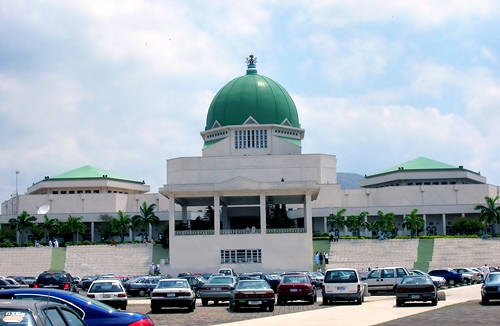
National Assembly, Abuja
In a 12-page statement titled, ‘The President’s Budget Speech: Our Response” and signed by the Chairman, Senate Committee on Media and Public Affairs, Senator Aliyu Sabi Abdullah and Chairman, House of Representatives Committee on Media & Public Affairs, Honourable Abdulrazak Namdas, the lawmakers defended their action
Read the full statement below;
The President’s Budget Speech: Our Response
We appreciate the fact that the 2018 Appropriations Law which was passed by the National Assembly on May 16th, 2018 was signed by President Muhammadu Buhari on Wednesday, June 20th, 2018.
In his speech at the signing ceremony, certain observations were raised about the work of the National Assembly and its Constitutional responsibility to modify and amend the budget estimates submitted to it by the Executive.
You may recall that when the National Assembly passed the 2018 budget, it gave reasons why the budget was increased and why certain projects and programmes had to be provisioned for. However, due to recent developments, it is once again necessary to let Nigerians know the justification for our actions on the 2018 budget, which were based on our Constitutional responsibilities.
Adjustments and reductions in the locations, costs and number of projects approved were made in order to address geopolitical imbalances that came with the Executive proposal. The introduction of new projects was done to ensure the promotion of the principles of Federal Character as contained in Section 14, subsection (3) of the 1999 Constitution of the Federal Republic of Nigeria as amended which states that “the composition of the Government of the Federation or any of its agencies and the conduct of its affairs shall be carried out in such manner as to reflect the federal character of Nigeria…”
The number of projects had to be increased in order to give a sense of belonging to every geopolitical zone of the country to ensure socio-economic justice, equity, fairness, and to command National loyalty.
Within the context of the provisions of Sections 4, 80 and 81 of the Constitution, everything that the National Assembly has done is within its powers.
Furthermore, Chapter 2 of the Constitution emphasizes the need for balance, inclusivity, and equity in the distribution of national resources. The annual budget, which symbolizes the distribution of these resources must reflect the aforementioned values, which we swore to uphold.
These Constitutional provisions, in addition to a recent Court judgment, have affirmed the fact that the budget process is a ‘joint effort’ that must reflect the input of both the executive and the legislature — the latter being the closest representatives of the people. However, we are fully aware that the Executive has the exclusive responsibility to execute all parts of the Appropriation Act once it is signed into law.
It is our firm belief that if the President had been properly briefed by his appointees, he would not have raised most of the concerns that he did in his remarks at the budget signing. It is therefore inevitable for the legislature to give members of the public an insight into what transpired during the appropriations process and how we arrived at the decisions that are contained in the 2018 budget.
With the aforementioned background, let us respond to each of the issues raised.
On the issue of the period when the budget proposal was submitted and when it was passed by the National Assembly, it is necessary to remind Nigerians that although the budget was submitted in November, as at March 15th 2018 (5 months and 8 days after the budget submission), Mr President was still directing the Secretary to the Government of the Federation to compel the Heads of Ministries, Departments and Agencies of the Federal Government to appear before the committees of the National Assembly to defend their respective budget.
In addition, up till April (6 months after the budget submission), the Executive was still bringing new additions to the 2018 budget which the National Assembly in good faith and in the spirit of collaboration and harmonious working relationship accepted.
More importantly, the 2017 budget, was signed into law on June 5th, 2017 and by the provisions of Section 318 of the Constitution, which defines the Financial Year as “any period of 12 months beginning on the first day of January in any year, or other date as the National Assembly may prescribe” – the 2017 budget lapsed on the 5th of June 2018. This same provision is replicated in the 2017 Appropriation Act.
It is important to also note that if not for the fact that the 2017 budget elapsed on the 5th of June 2018, the Federal Government would not have recorded notable capital projects for the just-ended financial year. This is because the Federal Government only started releasing funds for capital projects in December 2017 when the funds from the Federal Government’s loans were released and disbursed to contractors.
On the issue of an Organic Budget Law to improve the budgetary process, the proposed law is pending in the National Assembly and cannot be considered without the amendment of Section 81 of the 1999 Constitution (as amended) which gives the President the power to propose “estimates” at any time in the financial year. Nigerians need to know that during the last Constitutional Review exercise, the National Assembly in its wisdom amended this provision and it was approved by over two-thirds of the State Houses of Assembly.
The new Constitution Amendment requires the President to submit the budget not later than 90 days to the end of the financial year. As of today, the President has not yet signed this Constitutional Amendment Bill which would have helped us to have a proper budget calendar, which shall eventually lead to the realization of the proposed January to December budget cycle.
It was stated that the legislature made cuts amounting to N347 billion which were meant for 4,700 projects. Again, these reductions of N347 billion were made from low priority areas to higher priority areas to support the generation of employment for our youth by MSMEs. We took the decision to reduce the funds in some areas in order to ensure balance and equity in the spread and utilization of our national funds.
Additionally, the figures given amounts of the reductions made by the National Assembly were unduly exaggerated as we did not make any substantial reduction on any project to the extent of affecting its implementation.
To give the exact detail of the projects where we made deductions, it should be noted that the counterpart funding for the Mambilla Power Plant, Second Niger Bridge/Ancillary roads, the East-West Road, Bonny-Bodo Road, Lagos-Ibadan Express Road and Itakpe-Ajaokuta Rail Project, was reduced by only N3,956,400,290 – which represents only 1.78 % of the total N222,569,335,924 submitted by President Buhari. This left these projects with N218,612,935,634 which cannot negatively affect their implementation. This obviously contradicts the claim that these projects lost “an aggregate of N11.5 billion”.
Specifically:
The counterpart Funding for 3050mw Mambilla Hydropower Project was reduced from N8.5billion to N8.2billion (a reduction of N300million);
The construction of the Second Niger bridge including access roads phases 2a and 2b in Anambra and Delta states and other projects in the South East were reduced from N10billion to N9.1billion (a reduction of N900million);
The construction of Bodo-Bonny road with a bridge across the Opobo channel in Rivers State was reduced from N10billion to N8.7billion (a reduction of N1.3billion);
The funding for the Lagos-Ibadan Expressway was reduced from N20billion to N18billion (a reduction of N2billion), which would not significantly affect the construction of the road in one appropriations cycle;
The Railway Projects (Counterpart Funds): 1. Lagos-Kano (ongoing) 2. Calabar-Lagos (Ongoing) 3. Ajaokuta-Itakpe-Aladja (Warri) (Ongoing) 4. Port Harcourt- Maiduguri (New) 5. Kano-Katsina-Jibiya-Maradi in Niger Republic (New) 6. Abuja-Itakpe and Aladja (Warri)-Warri Port and Refinery including Warri new Harbour (New) 7. Bonny deep Sea Port & Port Harcourt of N162,284,335,924 was retained by the National Assembly as presented by Mr President; and
The National Assembly increased the aggregate funding for the East-West Road from N11,285,000,000 to N12,085,000,000 because we realized the strategic importance of the road to the entire oil producing areas of our country and the fact that the road project has lingered for too long;
Addressing the issue of the Second Niger Bridge project, apart from early works, as of today, there is no existing contract for the Second Niger Bridge in spite of frequent requests from the National Assembly. The N900million reduced from the N10billion proposed by the Executive was deployed to fund ancillary roads that connect to the Bridge. It should again be noted that the N12.5billion and the N7.5billion appropriated for the Second Niger Bridge in the 2016 and 2017 budget by the National Assembly were never utilized for the project.
We also need to call the attention of the public to the fact that the National Assembly allocated an additional N2billion to the Enugu-Port Harcourt Expressway project. This was more than the Executive proposed.
As part of the implementation of the 2017 budget, the contracts for 15 roads were awarded by the Federal Executive Council with no budgetary provisions. Realizing the importance of these projects, the National Assembly decided to spread the N3.9billion saved from the earlier mentioned projects funding to facilitate the take-off of these projects that include: the rehabilitation of Ikorodu-Shagamu road in Lagos State; the rehabilitation of 9th Mile-Orakam to Benue Border; and the general maintenance of Pankshin – Ballang – Nyelleng – Sararele – Gindiri road in Plateau State, etc.
These are the projects purported to be “project inclusions without conceptualization.” On these projects, the National Assembly needs to be commended by Mr President for helping to support the take-off of these awarded but unfunded projects.
Furthermore, it was stated that the budget of the FCT was cut by N 7.5 billion. This is true. The legislators stand by this decision because, through its oversight of the Federal Capital Territory (FCT), the National Assembly discovered that in the 2016 and 2017 budget cycle, there was a severe non-performance of the budgetary allocations to the FCT. During the two years in question, over 50% of the funds that were allocated and released to the FCT were not utilised.
These funds were ultimately returned to the treasury. Hence, in order to ensure that scarce resources were allocated in accordance to ‘needs over wants’, funding for the FCT which has historically been under-utilised were allocated to other MDAs that have demonstrated the capacity to implement their allocation for the development of the nation and its people. It was part of the allocation that we spread over the roads for which contracts were awarded with no budgetary allocation.
On the provisions for strategic interventions in the health sector which were said to be cut by an aggregate of N7.45billion, it is on record that for the first time since the National Health Act was enacted in 2014, the National Assembly made provision of an additional N55billion for funding primary healthcare through the Basic Primary Healthcare Fund which will be sourced from 1% of the Consolidated Revenue Fund.
Thus, contrary to the claim that the health sector suffered any budgetary cuts, we actually provided more funds that will make access to health services possible for over 180 million Nigerians.
The presence of this provision for primary healthcare will help us to eliminate the prevalence of maternal, infant and child mortality as well as create a healthier population. With this increased funding, we will be able to ensure that all Nigerian children get the necessary immunization that keeps various diseases away from them and ensure that mothers are well-catered for during childbirth.
On the issue of the 104 Unity Schools across the nation and the claim that N3billion was cut from their funding, Nigerians need to know that after careful consultation by the committees of the National Assembly with stakeholders in the sector, the National Assembly actually provided an additional N3.7billion more for meal subsidies in these 104 Unity Schools.
Furthermore, it was claimed that the provision for Construction of the Terminal Building at Enugu Airport was cut from 2 billion Naira to 500 million Naira and that this will further delay the completion of this critical project.
However, for the avoidance of doubt, it is necessary to again clarify that during the budget defense and oversight processes, the National Assembly discovered that out of the N2billion contract for the Enugu Terminal Building, N1.7billion had already been paid to the contractor. And what is left to complete this project is just N300million.
Hence, the National Assembly approved N500million for the project — which is even N200million more than was required. We refer Nigerians to a publication in THISDAY newspaper published in April and titled “Giving Enugu Airport a Facelift” and written by the newspaper’s Aviation correspondent, Chinedu Eze, where the Minister of State (Aviation), Mr Hadi Sirika was quoted as saying “We just last week released N1.7billion to the contractor and hopefully also, within the shortest possible time, we will release another N300million for him so that they can quickly finish the airport terminal. This will bring the airport to its desired standard.”
In the case of statutory transfers where the increase in the National Assembly’s budget was isolated, it is important to note that the increase in the oil price benchmark from the projected $45 to the actual price of $51 generated additional N523.65 billion for the Federal Government.
Thus, based on an agreement between the National Assembly and the Executive as represented by the Ministry of Budget and National Planning, the additional revenues were allocated among the three arms of government as follows:
The Executive’s proposal for the National Judicial Council was N100billion, however, the National Assembly appropriated N110billion which represents N10 billion increase;
The Executive’s proposal for the Niger Delta Development Commission (NDDC) was N71,195,023,529, however, the National Assembly appropriated N81,882,555,891 — which represents a N10,687,532,363 increase;
An additional N33,981,437,188 was also appropriated for the outstanding liabilities to the NDDC by the Federal Government to enable the commission to settle some of its contractors that were owed over N1 trillion;
The National Assembly received an additional N14.5billion in funding;
In order to ensure that they are able to meet their mandate, the National Assembly increased the Public Complaint’s Commission’s budget from the N4,200,000,000 proposed by the President to N7,480,000,000 — which represents a N3,280,000,000 increase; and
Lastly, the National Human Rights Commission’s budget was increased from N1.5billion to N3,013,745,000, which represents a N1,513,745,000 increase.
It is therefore very clear that the three arms of government benefited from the increase which was mutually agreed on with the Ministry of Budget and Planning. In fact, we have correspondences addressed to the leadership of the National Assembly from Ministry of Budget making requests on how to spread the increment arising from the Benchmark differentials.
It should be noted that the budget of the National Assembly as at 2014 was N150billion, which is still N10.5billion more than our current figure despite increased national challenges that requires: frequent public hearings held on almost a daily basis at high costs; and intense oversight, which has become more thorough and incisive in order to check the Executive. The N139.5billion budget of the National Assembly represents less than 1.5percent of the entire N9trillion budget. Does it not make sense to use 1.5percent to protect the other 98.5percent?
The public should note that this increase in the legislature’s budget was also necessitated by the drastic inflation of the last four years; the need to rehabilitate the National Assembly’s deteriorating facilities, like the elevators which shut down almost weekly; spending hundreds of millions to procure diesel to constantly power the entire complex; and the need to immediately upgrade the security facilities of the complex. It is important to point out at this juncture that the collapse of the CCTV system facilitated the mace theft in April.
Finally, the following 24 additions, which were done to the 2018 Appropriations Bill, due to the increase in the benchmark price of oil were duly appropriated by the National Assembly after full consultations, and in many cases, requests by the Executive branch through the Ministry of Budget and National Planning.
S/N Project Name Amount
1 Augmentation to unity schools meal subsidy in Education Sector 3,701,587,104
2 Outstanding liability on exchange rate differential for 2015 & 2016 Bea ongoing remittances to 12 Bea countries (scholarship) 3,265,720,064
3 Rehabilitation of block C, D, G & H at the Headquarters and Lagos state office of Federal Ministry Of Industry, Trade & Investment 1,207,942,115
4 Construction of Kashimbilla/Gamovo multipurpose dam 2,000,000,000
5 Strengthening public health against LASSA fever/other outbreaks: procurement and installation of incinerators, procurement of personal protective equipment, ribavirin and laboratory reagents and training of health personnel, construction of isolation ward at university of Abuja teaching hospital, Gwagwalada 2,000,000,000
6 Fast Power Programme Accelerated Gas and Solar Power Generation 12,500,000,000
7 Expansion and reinforcement of infrastructure in 11 distribution companies to reduce stranded generation capacity 30,000,000,000
8 Alternative energy development fund 1,000,000,000
9 Completion of headquarters building (FMWA) 500,000,000
10 Construction of 3000 capacity maximum security prison in Abuja (Phase I) 6,031,862,972
11 Procurement of 3 x jf17 thunder aircraft 12,792,939,682
12 Security vote (including augmentation of shortfall in operational funds) for Nigerian Navy 3,000,000,000
13 Department of state security – pensions (including arrears) 6,318,326,710
14 Contributions to international Organisations 11,000,000,000
15 Contingency 2,800,000,000
16 Military operation: Lafiya dole & other operations of the armed forces 3,000,000,000
17 Subscription to shares in international Organisations 11,000,000,000
18 SDG special projects 3 8,000,000,000
19 Contingency (capital) 2,000,000,000
20 Promotion, recruitment & appointment for police service commission 5,393,947,080
21 Additional provision to some security agencies 10,000,000,000
22 Additional provision of 82b naira on critical federal roads e.g. rehabilitation of Abuja-Kaduna-Zaria-Kano 10b naira, rehabilitation of Lagos-Badagry-Seme road 4b naira, rehabilitation/dualisation of Calabar-Itu-Ikot Ekpene-Aba-Owerri Road 7b 92,000,000,000
23 Additional 12b naira to new federal universities 12,000,000,000
24 National Institute for Legislative Studies (NILS) 4,000,000,000
TOTAL 245,512,325,726
It is important to state that on many occasions, Mr President emphasized to the nation the urgent need to develop our human capital, which are our people and especially the youth. It is on this note that the National Assembly should be commended to the degree that most of the human development projects were captured in the budget by the legislature.
Nigerians should note that due to the back and forth that we have experienced in the past, the improvement of the budgetary process should be a higher priority than trading blames. This trading of blames and unnecessary scapegoating is not healthy — as it creates needless conflict between the two arms of government.
Finally, in order to ensure that all Capital Projects in the 2018 budget receive their necessary financing in the 2018 budget, we call on Mr President to present the borrowing plan to the National Assembly so that we can approve it.
We, therefore, want to urge all Executive appointees to ensure that they brief Mr President with the truth and facts of their engagement, to promote healthy and harmonious relationships between the Executive and the Legislature.